
Nov-27-2026
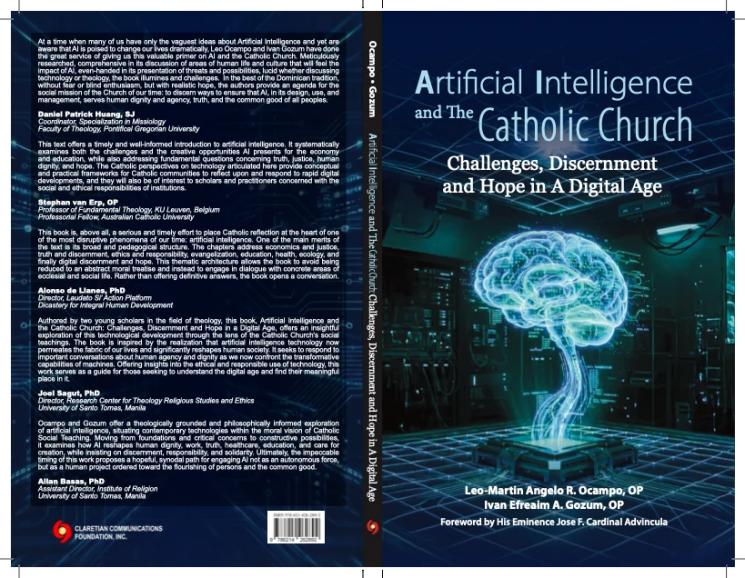
Both authors are academic staff members of the UST Institute of Religion (IR) and Research Associates of the UST Research Center for Theology, Religious Studies and Ethics (RCTRSE). Their new publication brings together theological reflection, ethical analysis, and practical applications to examine the implications of artificial intelligence for the Church and society.
The book situates the rapid development of AI within broader questions concerning human dignity, freedom, responsibility, relationships, education, work, communication, governance, and the common good. It likewise considers the opportunities and challenges that AI presents for the Church’s mission, including religious education, pastoral ministry, evangelization, and theological reflection.
Rather than viewing AI simply as a technological innovation, Ocampo and Gozum approach it as a development that invites deeper reflection on what it means to be human and on how technology can serve authentic human flourishing. The authors underscore the importance of discernment in navigating the possibilities and risks of AI, drawing from the rich resources of Catholic theology and ethics.
In his foreword to the book, Cardinal Advincula described AI as “one of the most important transformations of our age.”
“It is rapidly reshaping how we work, communicate, govern, learn, and even how we understand ourselves as human persons,” the Cardinal said. He emphasizes that, as with other profound social and technological transformations, “the Church is called not merely to observe these developments from a distance, but to engage them with wisdom, moral clarity, and evangelical hope.” The Archbishop then commended the authors for their thoughtful and interdisciplinary approach to the subject:
“This book … tries to respond to that call with commendable seriousness and insight,” he writes. “Leo-Martin Angelo R. Ocampo and Ivan Efreaim A. Gozum of the Pontifical and Royal University of Santo Tomas bring together theological reflection, ethical analysis, and concrete application to address one of the most pressing questions of today: how the Church may faithfully and effectively accompany humanity as AI increasingly mediates and transforms human life.”
The book has also received commendations from scholars and theologians for its comprehensive and accessible approach.
Fr. Daniel Patrick Huang, SJ, Coordinator of Missiology at the Faculty of Theology of the Pontifical Gregorian University in Rome, describes the volume as a valuable primer at a time when many people have only a limited understanding of AI despite its potential to dramatically reshape human life. He praises the book as “meticulously researched” and “comprehensive in its discussion” of the areas of human life and culture that will be affected by AI, while noting that it remains “even-handed in its presentation of threats and possibilities” and “lucid whether discussing technology or theology.” For Huang, the authors’ approach reflects the best of the Dominican intellectual tradition: “without fear or blind enthusiasm, but with realistic hope.”
Stephan van Erp, O.P., Professor of Fundamental Theology at KU Leuven, Belgium, and Professorial Fellow at Australian Catholic University, likewise describes the book as “a timely and well-informed introduction to artificial intelligence.” According to Van Erp, the Catholic perspectives on technology articulated in the book provide “conceptual and practical frameworks for Catholic communities to reflect upon and respond to rapid digital developments,” while also offering insights for scholars and practitioners concerned with the social and ethical responsibilities of institutions.

Latest on